Batumi is the easternmost port most Black Sea itineraries reach, and the arrival tells you so. The coast that runs south from the Caucasus turns here towards Turkey, and the mountains come down almost to the water: on a clear morning the first ridges of the Ajaran hills stand directly behind the city, dark with forest, often with cloud caught along their tops. In front of them sits a narrow plain of streets and a seafront of new towers, some sober, some very much not. Batumi is the capital of Ajara, an autonomous republic within Georgia, and a port that has spent the last century and a half shipping things to the rest of the world.
Arriving in the bay
Ships calling here usually berth at the passenger quay inside the commercial port, at the northern end of the city, where the bay is sheltered by a short breakwater. From the rail you see the cranes and oil tanks of the working harbour on one side and, on the other, the tip of the seafront park with its lattice tower and Ferris wheel. The water inside the harbour is often a milky green after rain in the hills, darker and bluer beyond the breakwater. Rain is worth mentioning early: Batumi has one of the wettest climates on the Black Sea, warm and humid, with heavy downpours possible in any month and especially in autumn.
The port gate opens almost straight onto the old town, so there is no need for transport. Georgia uses the lari, and small notes are useful for coffee, a bottle of water or a museum ticket; cards are widely accepted in the centre.
Along Batumi Boulevard
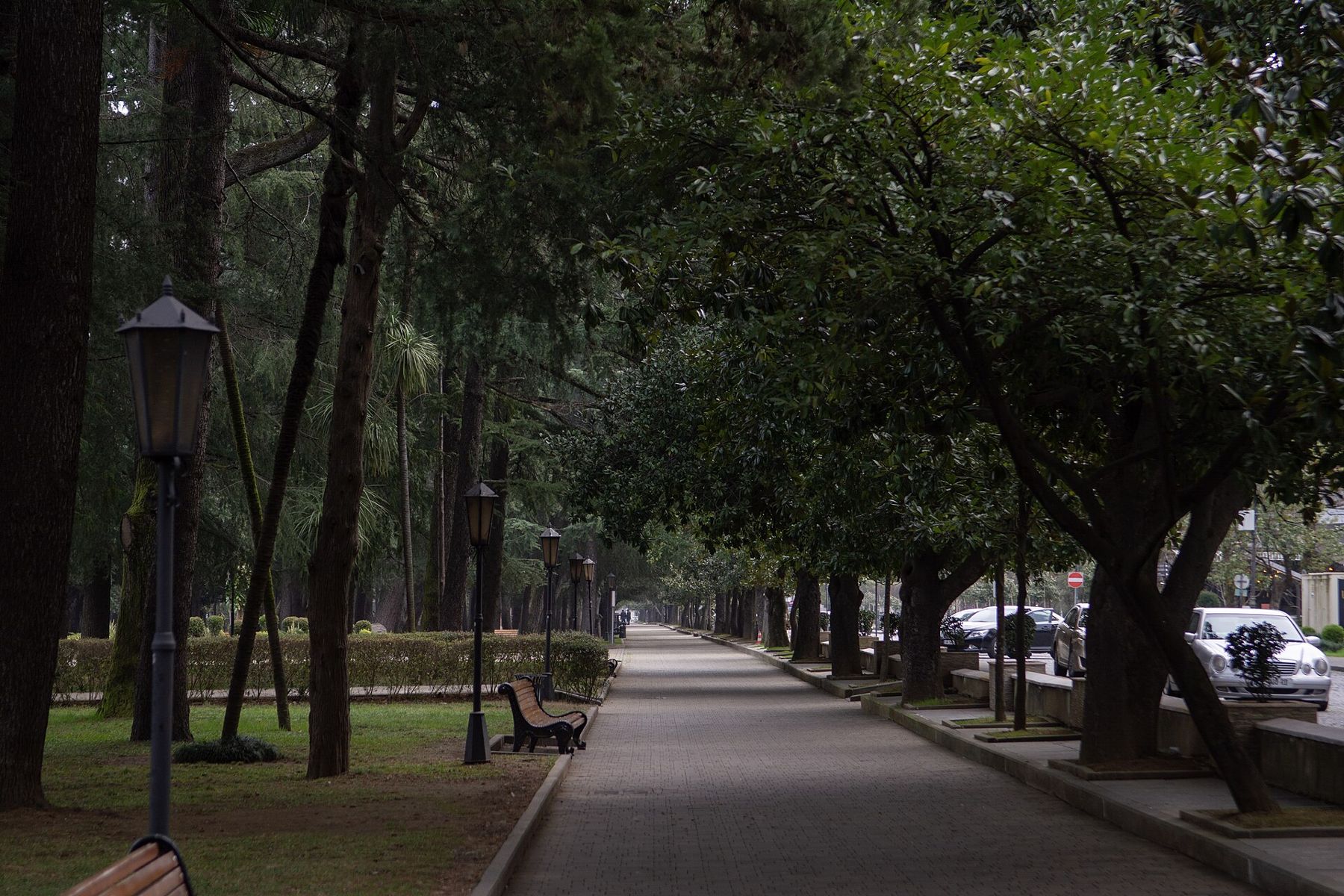
The boulevard is the spine of the city's seafront, a park several kilometres long running south-west from the port along a pebble beach. Its oldest section dates from the 1880s, when Batumi had just become part of the Russian Empire and was growing fast, and the planting shows its age in the best way: tall pines and cedars, palms, and long avenues of magnolia that close overhead into a dim green tunnel. Paths for walking and a separate cycle lane run side by side for most of its length, and benches face the sea every few metres.
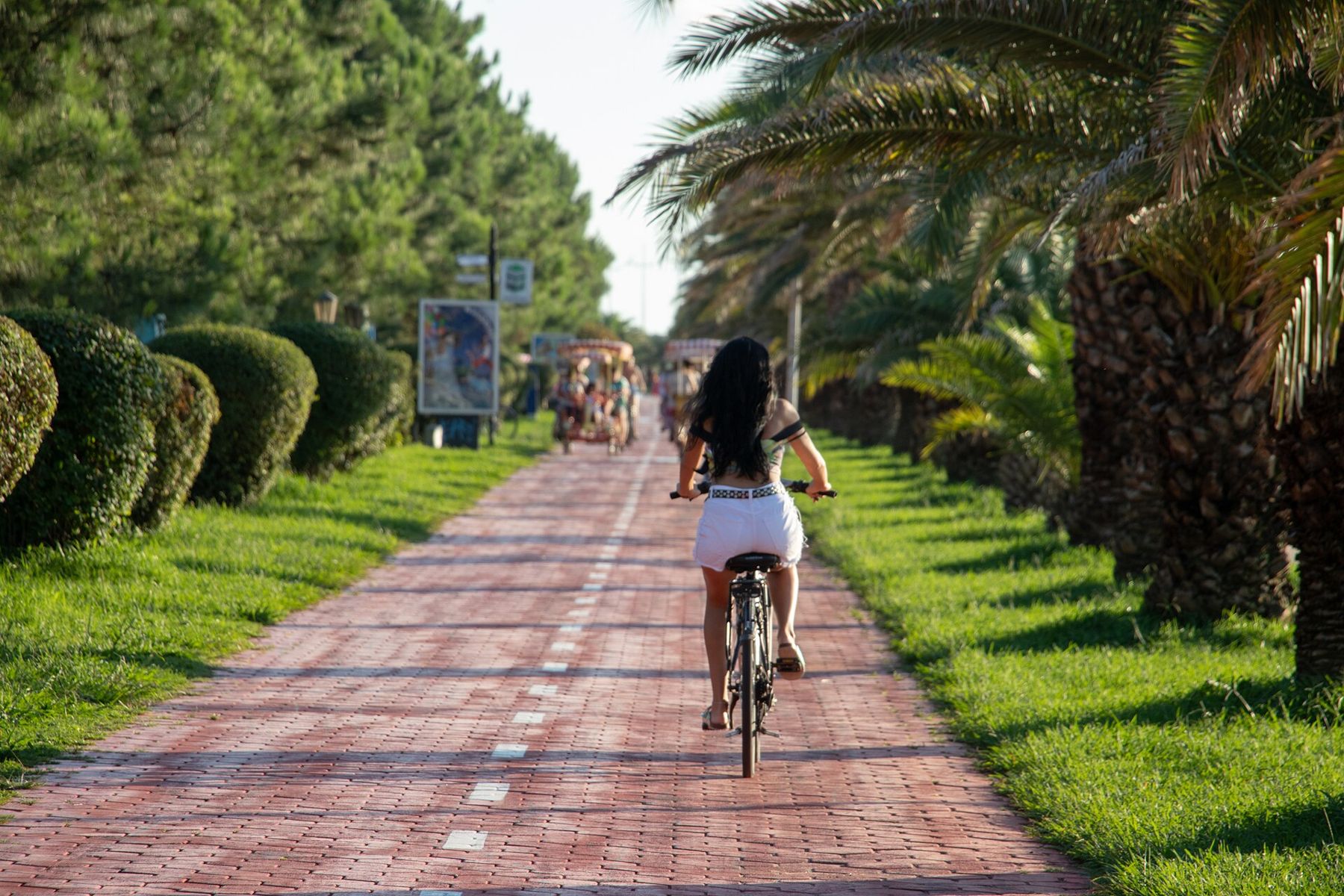
You do not need to walk all of it. An hour heading south from the port takes you past the oldest gardens, a small lake with fountains, sculptures, cafés and play areas, and then into the newer stretches where towers line the inland side. Turn back whenever the pebbles and the sound of the surf have done their work. The beach shelves steeply, and swimming from it is possible in summer, though the stones are hard on bare feet.
Europe Square and the old town
Turn inland from the port and within a few minutes you are in Europe Square, a broad open space surrounded by tall, ornate façades and dominated by a column carrying a gilded statue of Medea holding up the golden fleece. The figure ties the city to the old story of Jason and the Argonauts, who are said to have sailed this coast in search of the fleece in the kingdom of Colchis. One of the buildings on the square carries a large astronomical clock on its front.
The streets around the square are the old town proper: low houses of the late nineteenth and early twentieth centuries, many with wrought-iron balconies, built when the port was booming on oil brought by rail from Baku and shipped out from here. Several faiths built in these streets, and their houses of worship stand within a short walk of each other: a nineteenth-century mosque, a cathedral raised at the start of the twentieth century as a Catholic church and now Georgian Orthodox, a synagogue and an Armenian church. Most are open to visitors outside services if you dress modestly.
The grid is small and easy, and the side streets are where the city feels least like a resort: courtyards hung with washing, fruit stalls and vines trained over doorways. The market district lies a little further east if you want to see heaps of hazelnuts, churchkhela strings, cheese and spices.
The towers and the figures by the water
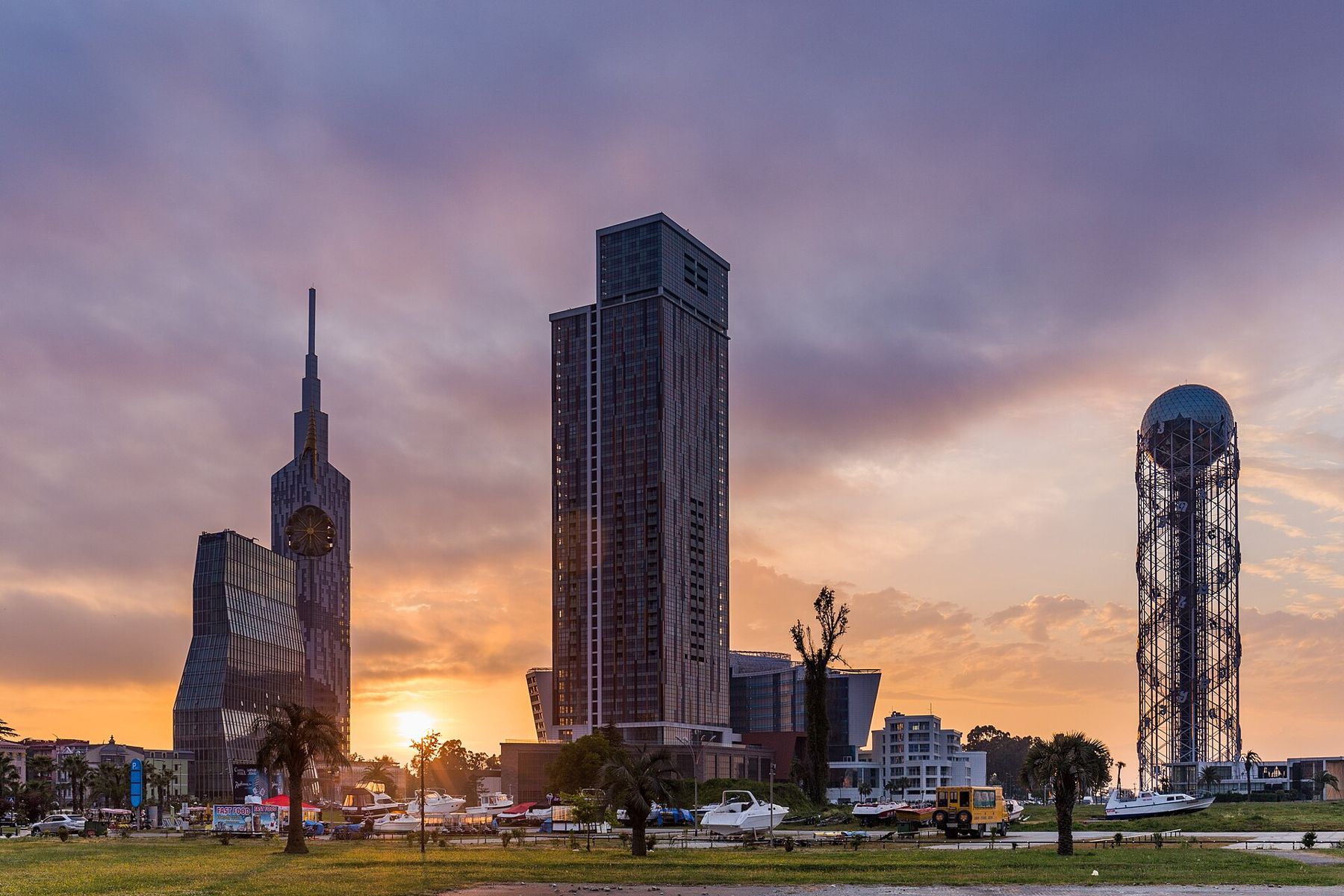
Back at the northern tip of the seafront, close to the port, is the stretch of park where Batumi shows off. The Alphabetic Tower, about 130 metres tall and finished early in the 2010s, wraps a double helix of steel around its core, with the 33 letters of the modern Georgian alphabet set along it in large metal forms. A sphere sits on top. You will have seen it from the ship; from the foot of it you can follow the letters up the spiral and try to match them to the script on every shop sign in town.
A few minutes' walk along the water stand the two steel figures known as Ali and Nino, after the 1930s novel of a Muslim boy and a Christian girl whose love is crossed by war in the Caucasus. The sculpture moves: over several minutes the two figures, built of stacked horizontal slices, glide towards each other, pass through one another and draw apart again. It works by day, but the effect is strongest after dark, when the figures are lit in shifting colours and the Ferris wheel turns beside them.
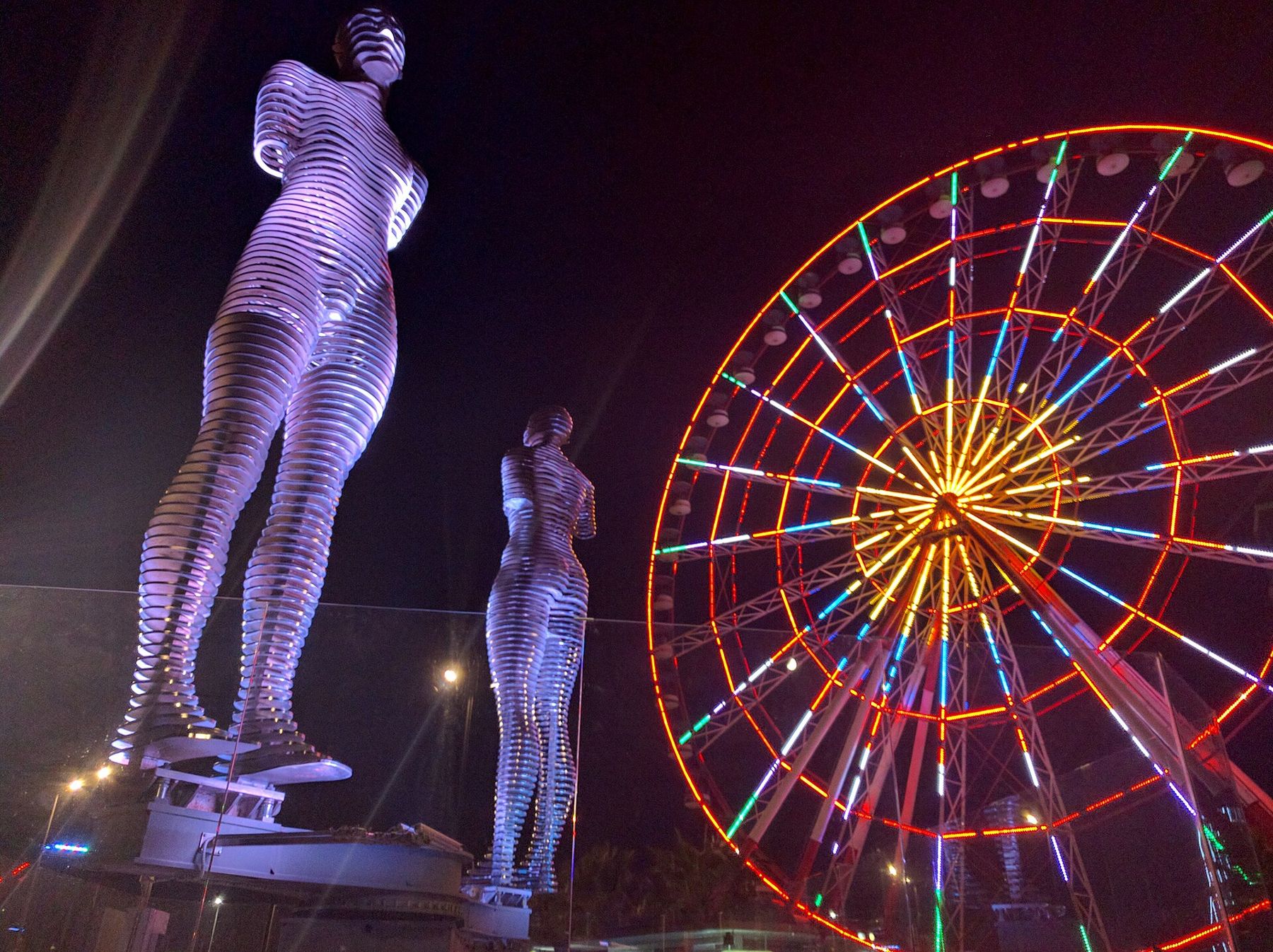
The sculpture moves: over several minutes the two figures, built of stacked horizontal slices, glide towards each other, pass through one another and draw apart again.
The mountains behind
From almost anywhere in the city you can look up and see the hills. A cable car climbs from near the port area to a viewpoint high above the town, and on a clear day the ride shows the whole shape of the place: the curve of the bay, the port, the line of towers along the boulevard and the coast running south towards Turkey, only a short drive away. On a cloudy day the top may sit in mist; ask at the station whether the view is open before you buy a ticket.
If you have a full day, the hills themselves reward the effort: villages, old stone bridges and waterfalls lie within an hour or two inland, described in our story on the Ajaran hills. Closer to town, the subtropical collections of the botanical garden cover a steep headland a few kilometres north, and to the south the Roman walls at Gonio are a short taxi ride away.
Four hours in Batumi
- Old town and Europe Square first, while it is cool: an hour on foot.
- The northern end of the seafront: the Alphabetic Tower, Ali and Nino and the harbour views, another hour.
- The boulevard south for as long as you like, then back to the port along the inland streets.
- Leave margin at the end: the walk back is short, but heavy rain can arrive quickly and slow everything down.
Batumi rewards an unhurried pace more than a list. The city is easy to read from its own seafront, and the best of it, the trees, the mountains and the light on the bay late in the afternoon, needs no ticket. Batumi is also where the eastern loop of the sea turns back west, past the tea slopes and the monastery above Trabzon on the Turkish shore.
More ports on this coast: Batumi and Ajara.