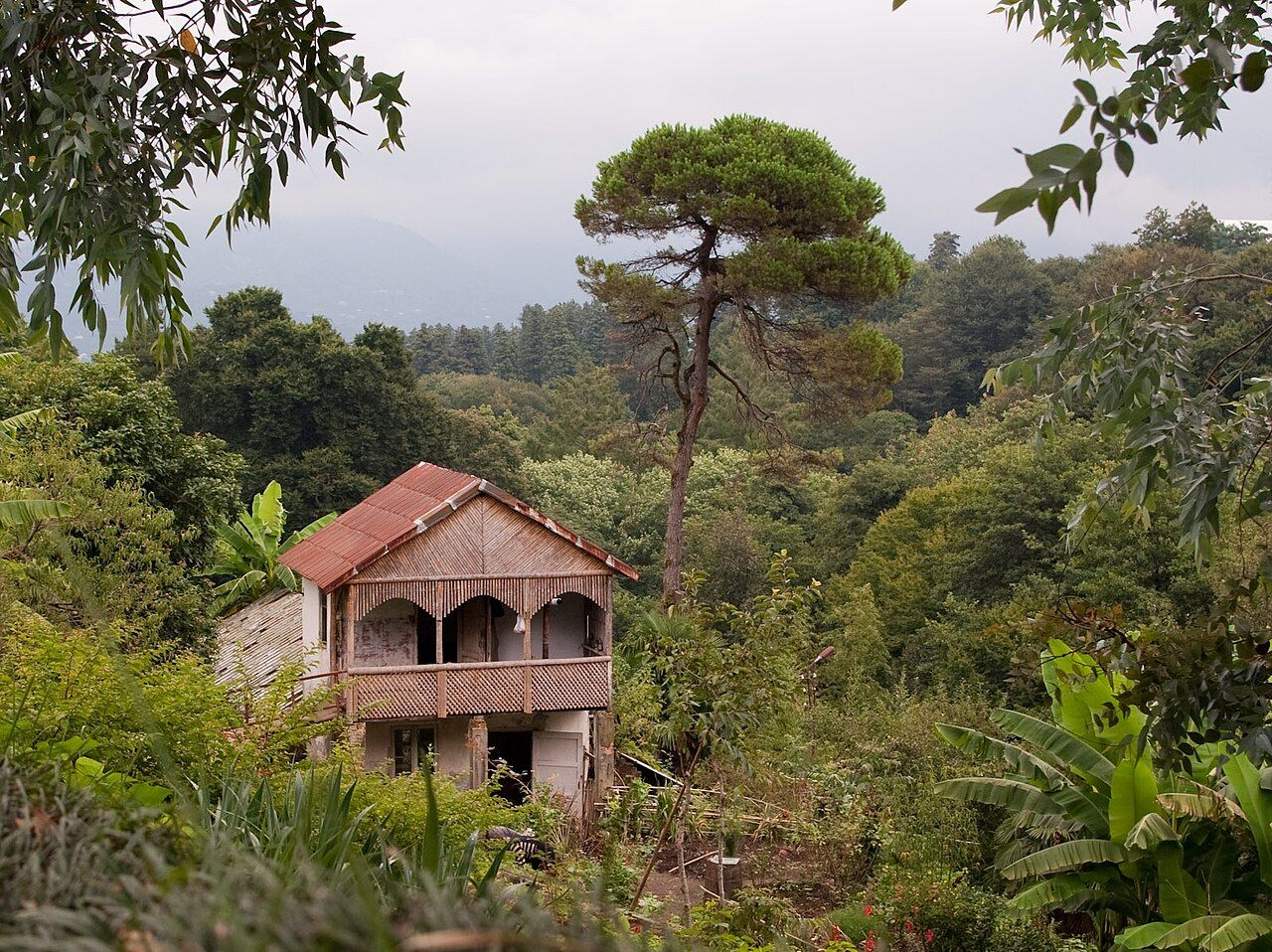
A few kilometres north of Batumi the coast road bends round a steep, densely wooded headland. Seen from the sea it looks like a piece of wild forest, but the trees are from every continent: palms and bamboo, eucalyptus and magnolia, Japanese maples, Himalayan pines and New Zealand flax, planted over more than a century on terraces cut into the slope. This is the Batumi Botanical Garden at Mtsvane Kontskhi, the Green Cape, and on a port day in Batumi it is the best escape from the heat and noise of the boulevards.
Mtsvane Kontskhi, the Green Cape
The headland rises steeply from a narrow shore, where the railway line runs along the coast, to a ridge of low hills behind. Its position is the key to the garden. The Ajaran coast has a humid subtropical climate, with mild winters, warm wet summers and some of the heaviest rainfall in this part of the world, as the moist air off the sea meets the mountains straight behind. Plants that would struggle almost anywhere else on the Black Sea grow here easily, and the slopes give each collection its own exposure and shelter.
The garden covers more than a hundred hectares, and because most of it is on a slope, its paths rise and fall constantly. Even a short visit involves a good deal of climbing.
A garden founded in 1912
The garden was founded in 1912 by the botanist and geographer Andrey Krasnov, at a time when this coast belonged to the Russian Empire and scientists were experimenting with subtropical crops such as tea and citrus along the shore. His idea was to bring together the vegetation of the world's humid subtropical regions, arranged so that a visitor could walk from one part of the world to another. Krasnov is buried in the garden, on a spot overlooking the sea.
Through the twentieth century the garden served as a research station as well as a public park, and it still works as a scientific institution, with nurseries and collections beyond the paths visitors use. Its age shows in the best way: many of the trees planted in its first decades are now very large, and the planted areas have grown into something close to forest.
The world by region
The collections are laid out by phytogeographic region, which in practice means you move through a series of distinct landscapes. The East Asian sections are the most extensive, with Japanese and Chinese trees and shrubs, camellias, magnolias and stands of tall bamboo that creak and knock in the wind. The Himalayan section brings pines and rhododendrons; the North American one has tulip trees and magnolias of the eastern United States; the Australian and New Zealand sections are dominated by eucalyptus, tall and pale-barked, with their unmistakable smell on a warm day. There are Mediterranean, South American and Mexican sections too.
Between them, and perhaps the most interesting for a visitor from elsewhere, is the native Colchic forest of the region itself: chestnut, beech, hornbeam and an evergreen understorey that is a survivor of much older, warmer times. Signs give names and regions, and a map at the entrance helps you choose a route. On some of the lower slopes, small plantings of tea and citrus recall the experiments that first brought these crops to the coast.
Views over the sea
The garden's paths come out regularly onto viewpoints over the water, and these are the moments that stay with you. From the upper terraces you look out over the curve of the coast towards Batumi, its towers small and pale in the distance, and down over treetops to the narrow shore and the railway. In clear weather the Ajaran mountains stand behind the city; on a hazy day the sea and sky merge into one pale wall.
Early morning, before the heat, is the best time for the views and for the light under the trees. By midday the haze often thickens and the colours flatten.
Heat, slopes and rain
Do not underestimate the walking. The paths are well made but steep in places, with steps, and the humidity in summer makes even a gentle climb hard work. Carry water, wear a hat, and allow more time than the map suggests. The garden is shaded in many sections, but open stretches between them can be very hot in July and August. If it rains, as it often does, the paths become slippery, though the garden looks its best then, dark and dripping.
There are two main entrances, an upper one near the main road and a lower one close to the shore. The most comfortable way to see the garden is to enter at the top and walk down, finishing at the lower gate near the sea; going the other way means ending your visit with a long climb. Entry is paid in Georgian lari.
Twenty minutes up the coast
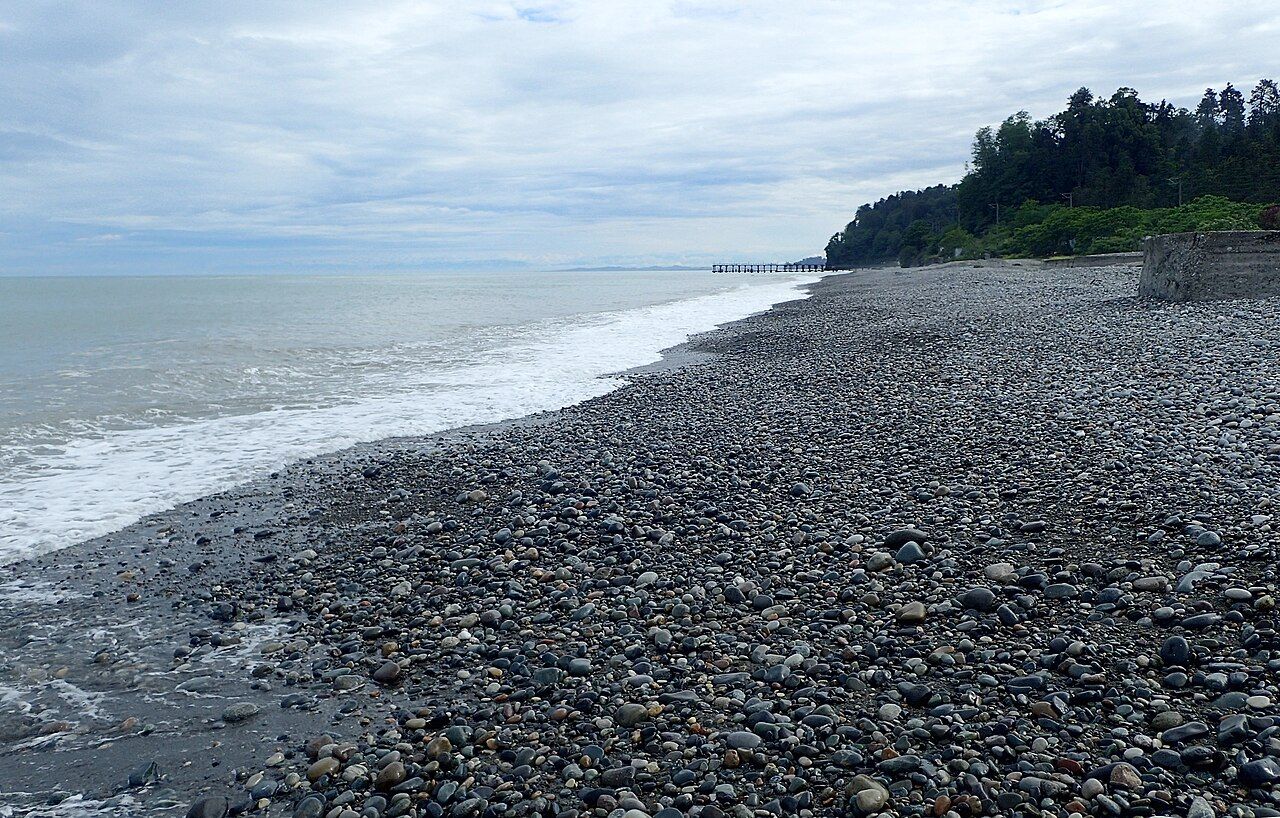
Mtsvane Kontskhi is about twenty minutes by road from the centre of Batumi, depending on traffic. Taxis are the simplest option and are easy to find near the port; agree the fare first or use a metered service. City minibuses also run along the coast road, and the railway passes below the garden. Half a day is enough to see the main sections without hurry and return to the ship. Near the lower gate, the pebble shore at Mtsvane Kontskhi is a good place to cool down after the walk, with the garden rising behind you and the railway between.
The garden pairs naturally with a walk through the city itself, described in Batumi from the cruise pier. With more time, you can head inland for the Ajaran hills, or south to the Roman fortress at Gonio near the border. The climate that makes this garden possible is the same one that grows tea across the border at Rize.
More ports on this coast: Batumi and Ajara.